LED vs Traditional Lighting: A Cost Comparison for Business Owners
January 22, 2026
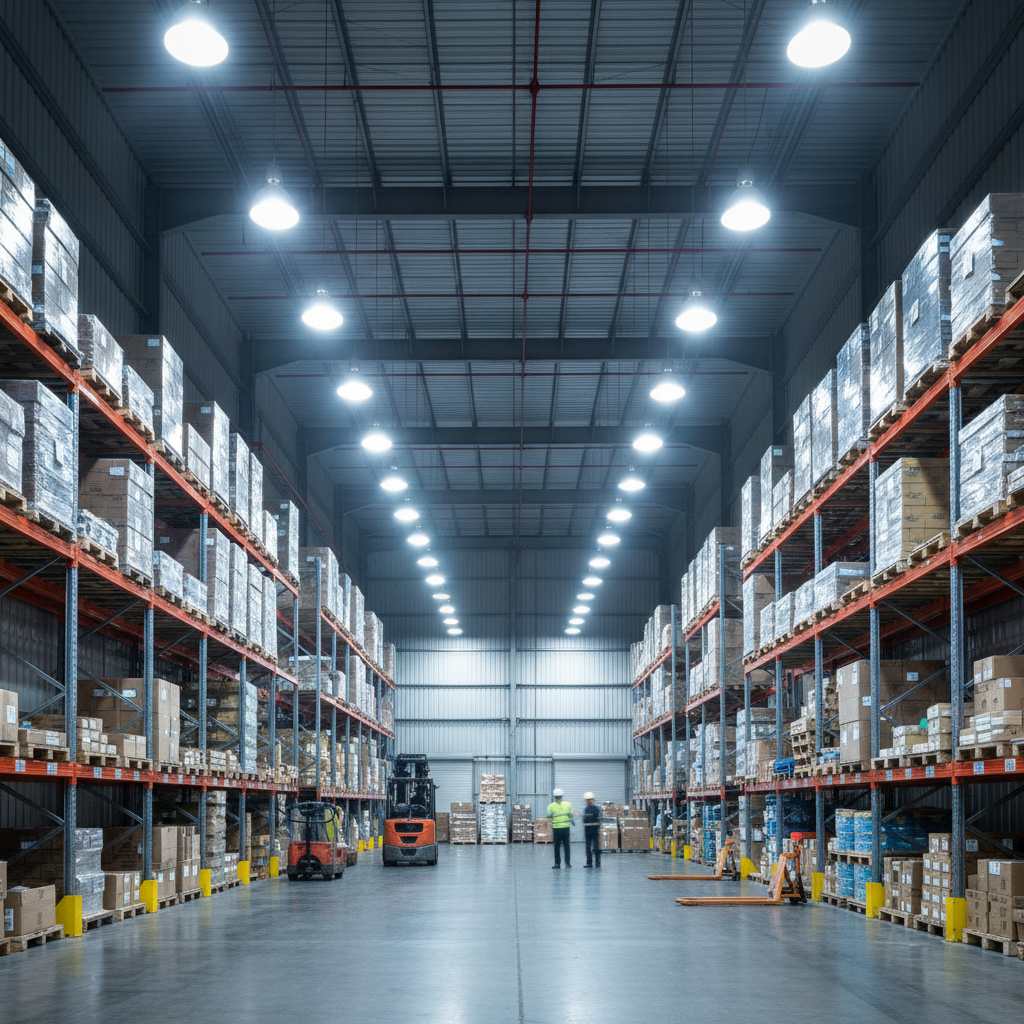
Choosing the right LED high bay light for your warehouse, distribution center, or manufacturing facility is one of the most impactful decisions you’ll make for operational efficiency and employee safety. The right fixture delivers optimal visibility, reduces energy costs by 40-70%, and lasts 100,000+ hours — virtually eliminating maintenance. The wrong choice leads to dark spots, glare complaints, and wasted money.
This guide covers everything you need to know to make the right decision for your facility.
Understanding High Bay Lighting
High bay lights are designed for spaces with ceiling heights of 15 feet or more — typically warehouses, factories, gymnasiums, and large retail spaces. They differ from low bay fixtures in their optics, lumen output, and mounting configurations. The two most common form factors are:
- UFO High Bays — Round, compact fixtures ideal for open warehouse spaces. Easy to install with hook-and-chain or pendant mounting. Best for general area lighting with mounting heights of 15-30 feet.
- Linear High Bays — Rectangular fixtures that distribute light in a wider pattern. Ideal for aisle lighting in warehouses and retail environments. Available in 2ft and 4ft lengths with continuous row mounting options.
Key Factors to Consider
1. Lumen Output
Lumens measure total light output — the higher the lumens, the brighter the fixture. For warehouse applications, the IES (Illuminating Engineering Society) recommends:
- General warehousing: 20-30 foot-candles (approximately 15,000-25,000 lumens per fixture at 25ft mounting height)
- Manufacturing / assembly: 30-50 foot-candles (25,000-40,000 lumens)
- Detailed inspection areas: 50-100 foot-candles (40,000+ lumens)
Don’t just look at wattage — two 150W fixtures can have vastly different lumen outputs depending on LED chip quality and optical efficiency. Always compare lumens per watt (efficacy). Modern high bays should deliver 130-180 lumens per watt.
2. Wattage and Energy Consumption
LED high bays typically range from 100W to 600W, replacing 250W to 1,500W metal halide or HPS fixtures. A common retrofit scenario:
- 400W metal halide → 150W LED (62% energy reduction)
- 1,000W metal halide → 300W LED (70% energy reduction)
Many modern fixtures offer wattage selectability — a single fixture with a DIP switch that lets you choose between 3-5 wattage settings. This provides flexibility during installation and simplifies inventory management for contractors.
3. Color Temperature (CCT)
Color temperature is measured in Kelvin (K) and affects how the light looks:
- 4000K (Neutral White): Natural, comfortable light. Good for manufacturing, retail, and mixed-use spaces.
- 5000K (Daylight): Bright, crisp light. Preferred for warehouses, distribution centers, and spaces where task visibility is critical.
Many high bays now offer CCT selectability (tunable between 3500K-5000K), allowing you to adjust color temperature on-site without ordering different fixtures.
4. Mounting Height and Optics
The beam angle determines how light spreads from the fixture. Narrow beams concentrate light over a smaller area (good for high ceilings and aisle lighting), while wide beams spread light across a larger area.
- 15-20 ft ceilings: 120° beam angle
- 20-30 ft ceilings: 90° beam angle
- 30-40+ ft ceilings: 60° beam angle
5. Durability and IP Rating
The IP (Ingress Protection) rating indicates resistance to dust and moisture:
- IP65: Dust-tight and protected against water jets — suitable for most indoor applications and covered outdoor areas
- IP66: Protected against powerful water jets — ideal for food processing, car washes, and wet environments
- IP40: Basic protection — suitable for clean, dry environments only
6. Certifications and Rebates
Look for these certifications to ensure quality and rebate eligibility:
- DLC Premium: Required for most utility rebate programs. Ensures high efficiency and quality standards.
- UL Listed: Meets safety standards for the US market.
- ETL Listed: Alternative safety certification accepted by most jurisdictions.
Utility rebates can cover 30-50% of fixture costs. Our team at Stasy’s Art 2.0 identifies available rebates and handles the application paperwork for every project.
Installation Considerations
Beyond the fixture itself, consider these installation factors:
- Electrical infrastructure: Ensure your panel has sufficient capacity for the new fixtures. LED conversion often frees up significant capacity due to lower wattage.
- Controls: Occupancy sensors, daylight harvesting, and programmable dimming can add 20-40% additional energy savings beyond the LED conversion itself.
- Emergency lighting: Many high bays are available with integrated emergency battery backup, eliminating the need for separate emergency fixtures.
Making the Right Choice
Every facility is different. The best approach is a professional lighting design that considers your specific space dimensions, ceiling height, task requirements, and budget. At Stasy’s Art 2.0, we provide free lighting assessments and photometric designs for commercial projects. Our team will recommend the optimal fixtures, layout, and controls strategy — then handle the complete installation.
Ready to upgrade your warehouse lighting? Contact us for a free consultation, or browse our high bay collection to explore options.