LED vs Traditional Lighting: A Cost Comparison for Business Owners
January 22, 2026
Top 5 Energy-Efficient Lighting Upgrades for Commercial Buildings
February 19, 2026
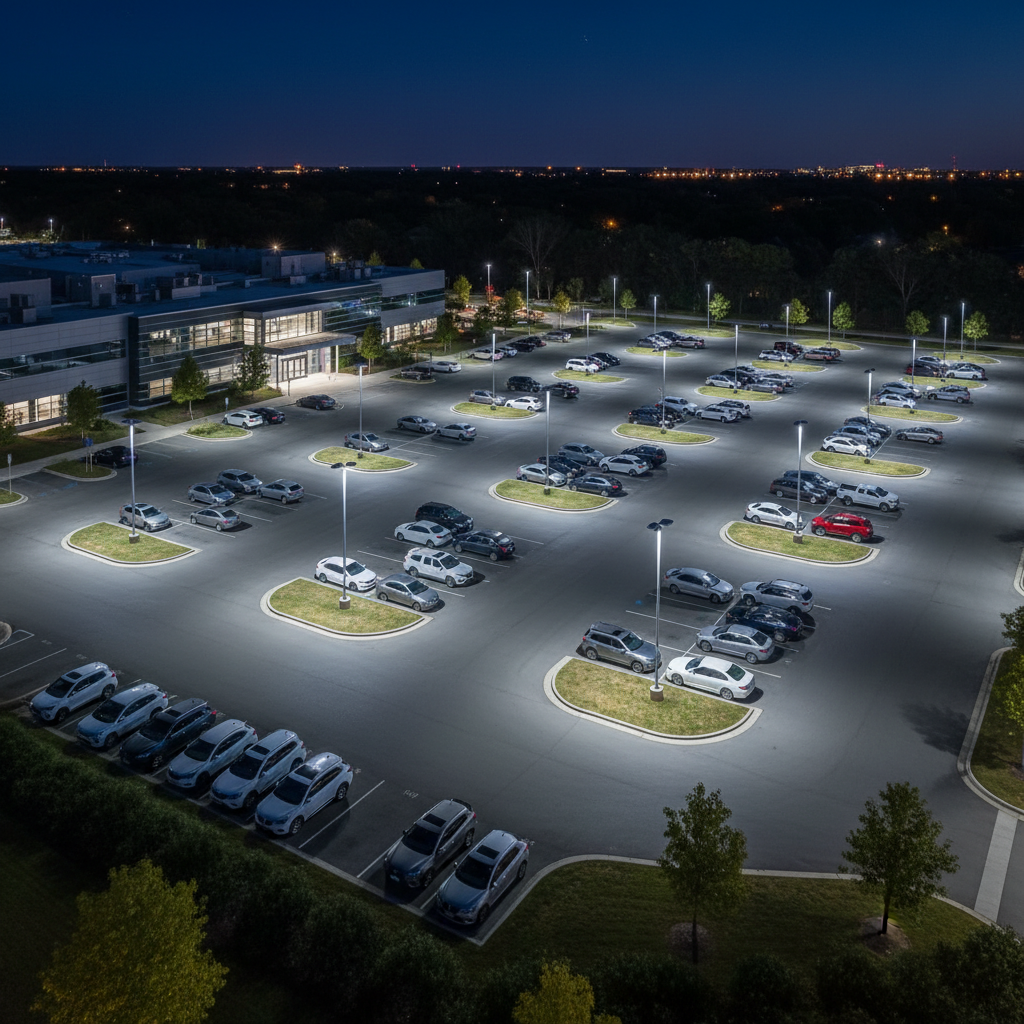
Parking lot lighting is one of the most critical — and often overlooked — aspects of commercial property management. Proper lighting enhances safety, deters crime, improves wayfinding, and creates a welcoming first impression for customers and employees. Poor lighting creates liability risks, reduces property value, and drives away business.
This guide covers the technical requirements, design principles, and best practices for commercial parking lot lighting.
Why Parking Lot Lighting Matters
According to the Bureau of Justice Statistics, approximately 7% of all violent crimes occur in parking lots and garages. Adequate lighting is the single most effective crime deterrent for these spaces. Beyond safety, well-designed parking lot lighting:
- Reduces slip-and-fall liability by illuminating curbs, speed bumps, and surface hazards
- Improves security camera effectiveness (cameras need adequate light to capture usable footage)
- Enhances brand perception — well-lit properties signal professionalism and attention to detail
- Meets insurance requirements and local building codes
IES Lighting Standards
The Illuminating Engineering Society (IES) publishes recommended light levels for parking facilities in RP-20. The key metrics are:
| Area | Min Foot-Candles | Uniformity Ratio |
|---|---|---|
| Open parking (basic) | 0.5 fc | 4:1 max |
| Open parking (enhanced security) | 1.0 fc | 4:1 max |
| Covered parking / garages | 5.0 fc | 10:1 max |
| Pedestrian walkways | 0.5-2.0 fc | 4:1 max |
| Building entrances | 5.0 fc | — |
Uniformity ratio is as important as overall brightness. A 4:1 ratio means the brightest point should be no more than 4x the dimmest point. Poor uniformity creates dangerous dark spots between pools of light.
Choosing the Right Fixtures
Light Distribution Types
LED area lights use optical lenses to direct light in specific patterns called “distributions”:
- Type II: Narrow forward throw — ideal for walkways and roadways
- Type III: Medium forward throw — most common for parking lots (mounts along the perimeter, throws light inward)
- Type IV: Wide forward throw — for fixtures mounted on building walls or property edges
- Type V: Square/circular pattern — for center-of-lot pole mounting with light in all directions
Fixture Wattage and Coverage
A rough guide for fixture selection based on pole height and spacing:
- 20ft poles, 60ft spacing: 100-150W fixtures
- 25ft poles, 80ft spacing: 150-200W fixtures
- 30ft poles, 100ft spacing: 200-300W fixtures
- 35ft+ poles, 120ft spacing: 300-500W fixtures
These are approximations — every site requires a photometric design to verify light levels and uniformity.
Smart Controls for Maximum Savings
Modern parking lot lighting should include intelligent controls:
- Photocell sensors: Automatically turn lights on at dusk and off at dawn
- Adaptive dimming: Reduce output to 50% during low-activity hours (midnight-5am), saving significant energy
- Motion sensors: Bring lights to full brightness when vehicles or pedestrians are detected
- Remote monitoring: Networked fixtures report failures and energy usage to a central dashboard
Adding smart controls to an LED parking lot system can reduce energy consumption by an additional 30-50% beyond the LED conversion savings.
Dark Sky Compliance
Many municipalities now enforce dark sky ordinances to reduce light pollution. Compliance requires:
- Full-cutoff fixtures: No light emitted above the horizontal plane (0% uplight)
- Shielding: Backlight shields to prevent light trespass onto neighboring properties
- Color temperature limits: Some jurisdictions restrict to 3000K or lower to reduce blue light impact on wildlife
Professional Design Services
A proper parking lot lighting project requires professional photometric design. At Stasy’s Art 2.0, we provide:
- IES-compliant photometric layouts with AGi32 software
- Pole placement optimization to minimize the number of poles needed
- Complete construction documents for permitting
- Fixture and pole procurement at contractor pricing
- Professional installation including foundations, conduit, and electrical
Need parking lot lighting? Contact us for a free site assessment and photometric design.